Showing posts with label food. Show all posts

Friday, July 24, 2009

Grocery Bike (& Friends)


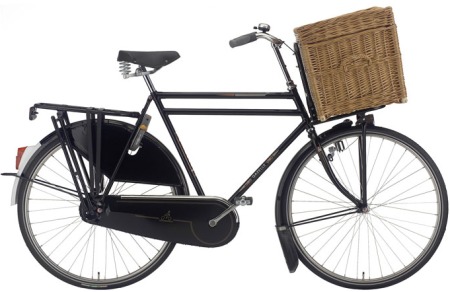
The Dutch have bikes for every occasion. One of my favorites the moederfiets (mother bike) for on-the-go moms (or dads!). A bakfiets (carrier bike) takes the place of the American pickup truck. The standard omafiets (Grandma bike), preferably old and beaten-up, is the bike of choice for urban errands and parking outside the pub (so you don't have to worry about it!). There are cargo bikes and tandem bikes and even a backseat-driver tandem bike that lets your kid think he's in charge by riding up front, while you steer from behind! Folding bikes are for hybrid commuters who must take them on the train (bringing a real bike requires a ticket for the bike, but a foldy is free!). The fietscafe is a bike that's also a bar (yeah, yeah, it has four wheels, so "bike" isn't quite the right word, but it does have a pair of pedals for each of its 12 barstools -- luckily the bartender gets to steer!). I've seen one of these and they look really entertaining.

I once saw an entire brass band on a bike in front of city hall in Eindhoven:


These guys are rad; check out their website.

Sadly, I don't have all these special bikes (although I am "average" by Dutch standards as the owner of 2.5 bikes: my commuter bike, mountain bike, and my half of the tandem my wife and I used to ride before we had a baby!), but my trusty Gazelle does great work as a boodschappenfiets (grocery bike). I affixed the milk-crate with some old climbing webbing, and it works great. This particular outing, I packed the crate FULL of heavy stuff (note the stiff canvas bags, wonderful, thanks to my Ma), hung another bag off the handlebars, and I even was able to tuck the stems of some lilies into the crannies. Did I mention that flowers are cheap in the Netherlands? Each bunch was €3.


Hoera! Lekker fietsen!

Wednesday, October 29, 2008

Mmmm... Old Cheese Sandwich...

The Netherlands is well-known as a cheese-loving -- in fact, generally dairy-loving -- nation. People here drink milk at lunch just like Americans drink diet soda. Personally, I'm not excited about milk, but I do love cheese. Gouda and Edam are the Dutch cheeses that most Americans have heard of, and I came here with high hopes to discover the local nuances of these and others.

Admittedly, doing so at the local grocery store may not be the best way to get started. However, Albert Heijn, the local food genius, comparable in spirit at least, if not in execution, to Danny Wegman, does quite well, so that's where I began. I think that a full comparison of Wegman's and AH would be quite interesting, but I'll save that for a different day.

The refrigerated cheese shelf at AH looks something like this:
Lots of choices, lots of differently colored packages, therefore lots of new cheeses for me to explore -- right? Well, I pored over my choices here for quite some time, and as far as I can tell, it's all pretty much the same kind of cheese. And, the interesting bit is, they never say exactly what kind of cheese it is! I suppose it's something like when my aunt-in-law, who is Chinese, said, "when I cook, I don't make Chinese food, I just make food!" Here, it's all Dutch cheese, which I presume means Gouda, so there's no need to specify!

Great, so what do all the choices represent? I analyzed the packages and found three independent dimensions of variation. First, and most obvious, is the form factor of the cheese: whether it be sliced, block, diced, etc., and how many grams of cheese are involved. Second, a numbering system that includes values like "21+" and "48+." I asked my colleagues at work, and apparently these numbers correlate with fat content, but aren't simply percent fat -- I'll leave that semi-unanswered for now. Third, the only verbal description of the cheese, with monikers like "jong," "belegen," and "oude."

Which reminds me of a tangential story from my third day of work. I left work for an appointment over my lunch break, meaning I missed lunch in the cafeteria (known as the canteen, by the way). When I got back, starving, I dropped into the mini-Albert Heijn in the complex where I work to grab a snack. Conveniently, Albert had made me a selection of packaged sandwiches, and I found one labeled "Oude Kaas." I know just enough Dutch to recognize the literal translation of this as "Old Cheese." Instinctively, my mind's Homer-voice thought, "Mmmm... old cheese sandwich...," and I couldn't not buy it! It was quite tasty, on a multigrain bun, and turned out to be just the thing for my mid-afternoon hunger.

Faced with the cheese selection at the real AH, I recalled my oude kaas sandwich, and figured that the oude cheese was old, or aged, and in fact the edges of the oude kaas slices are often a little darker, looking a bit like cheese that's been sitting out for a while. This is a good thing, I assure you, as the flavor gets quite nice with a little time! Later, I did some Google research, and indeed jong, or young, cheese is the least ripe, mildest variety, belegen (and extra belegen) is medium, and oude is well-aged (over 10 months!) and sharpest. Correlated with this dimension is the hardness of the cheese, and I read that the most oude cheese is rock-hard and is shaved instead of sliced. Mmmmm...

Eet smakelijk!


Friday, October 17, 2008

Bier Automaat

No, this isn't your typical American Pepsi machine... this one serves Heineken! I discovered this in our hotel, and by golly, I was obligated to give it a try. Yep, it works! Heineken in a can for €1.50. Homer would definitely "woohoo!" about that.

And, speaking of bier, it turns out that Dutch restaurants serve ridiculously tiny beverages -- that is, unless you order beer. If you order soda, water, or sparkling water, you invariably get a glass 0.2L bottle and a tiny tumbler to pour it into. 0.2 liters is 6.8 ounces, meaning less than 1 cup! For €2! For reference, a typical American vending-machine soda, at 20 oz, is thus just about exactly 3 Dutch servings. What I find interesting is that in the same restaurant with the 0.2L sparkling water, ordering a beer gets you about twice that volume, always poured neatly in a glass meant for the exact brand of beer you're getting, and often with a little paper skirt at the bottom to absorb the condensation. I think this disparity clearly illustrates the priorities here! Also, if the tidy, normal-sized beer isn't enough, in some places you can order a grote bier, or large beer, that is just about a pint -- perfect for the Brits in the house, I guess. I haven't attempted to order a grote water, but I have successfully gotten a carafe of tap water.

Back to the vending... Automaat is my new favorite Dutch word which appears to be used for any kiosk/service/vending machine. The machine that dispenses parking passes is a parkeer automaat; an ATM is a geldautomaat or bankautomaat; a coffee dispenser is a koffieautomaat; etc. For an interesting assortment of verkoopautomaten, or "machines that sell stuff," see this page. Based on all my newfound knowledge of automaten, and the aforementioned pictorial examples, I assume that the Heineken-hawking Pepsi machine may be properly called a Bierautomaat -- my new favorite machine.